sundial history

Butterton church sundial and memorial brass from Tideswell

Butterton Church sundial restored

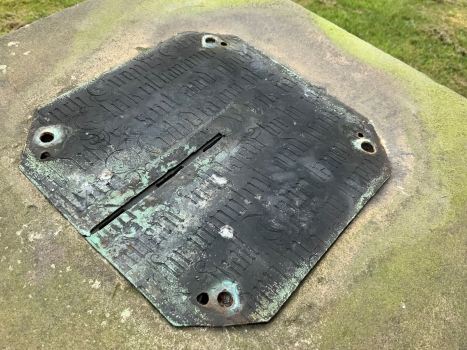
The Butterton church sundial has a new brass gnomon on the old dial plate. After many years outdoors the brass plate has turned green in colour. The Gothic script on the back of the plate shows it came from the Pursglove memorial in Tideswell church.

A few years ago we restored the sundial at St Bartholomew’s Church in the lovely Staffordshire village of Butterton. We found that the brass dial plate had ancient engraving in Gothic script on the underside, which was a mystery. The writing looked like part of a memorial brass, and we now know it came from Tideswell church in Derbyshire. Continue reading

Share:

Sundial stones in a Scottish garden — the restoration

Ancient sundial pillar after restoration

A falling tree broke off the top of this pillar in Storm Arwen. The two sundial stones fell down to the ground. The pillar now has a new top section matched to the original stone. The sundial sections are clean and restored.

In November 2021, Storm Arwen caused serious damage with very strong winds especially in eastern Scotland. On one country estate an oak tree crashed onto this historic sundial in the family garden. It smashed the ancient pillar supporting the sundial stones. The family wanted to see the sundial fully restored. Continue reading

Share:

Sundial stones found in a Scottish garden — the cruciform stone

Cruciform sundial stone

The cruciform stone has four concave sides leaving four curving arms between them, thus creating the cross shape. This particular stone has a small concave end on each curving arm [not visible in the photo]. So the single stone has eight dials, on four large concave sides and four small ones. [Note: the shadow in this photo is from indoor lighting not from the sun.]

The cruciform type of sundial stone is a clever idea. During the day, as the sun moves round, each of the dials in turn will show a shadow and indicate the time. The straight dial edges cast the shadows. A cruciform stone can be on a lectern sundial but this one appears unique. Continue reading

Share:

Sundial stones discovered in a Scottish garden — the stone globe

Globe terminator stone sundial

The globe sundial will show light and dark sides of the stone in sunshine. The terminator line separates the two and the hour numbers show the time.

This stone globe was initially puzzling. It has a band of hour numerals and looks like a type of sundial. It is actually a globe terminator dial. The hour band lies parallel to earth’s equator, and the line between light and dark shadow in sunshine is the terminator. The puzzle was why the globe had a second sundial  stone fixed onto it, since removed in the workshop, as a later post will explain. Continue reading

Share:

A modern altitude sundial after Erasmus Habermel

A modern circular altitude sundial after Erasmus Habermel of Prague

Modern reconstruction of a 16th century altitude sundial for studying its mathematics and accuracy. An altitude dial uses the height of the sun to find the time. The dial is double-sided with the two half-years back-to-back.

Erasmus Habermel was a renowned scientific instrument maker working in the court of Emperor Rudolf II in Prague in the 16th century. He made instruments for all disciplines including astronomy and navigation. One of his sundials is an altitude dial in the clocks collection of the Augustine Museum in Freiburg im Bresgau*. It is an elegant circular dial and the mathematical construction is intriguing. Continue reading

Share:

Historic Scottish Stone Sundial Restored

Scottish stone sundial restored

The octagonal base and baluster shaft support a carved cube stone. Before restoration the stones were covered in moss lying on the ground in the owner’s garden. The bronze horizontal dial is new.

Stone sundials were common in Scotland in the 17th and 18th centuries. They stood in the gardens of great houses, and in public places. The geometric form of the sundial would reflect the popular interests of the day in science and mathematics, and many displayed complex multiple dials. Originally this particular sundial may have belonged to a country estate near Falkirk. The present owner has had it for many years and in 2023 decided to restore it. Continue reading

Share:

Sundial restoration at Butterton church turns up a mystery engraving

Brass sundial plate turned over and showing engraved writing on the back

The engraving looks like Gothic script but we didn’t know how to read it. We do hope to learn more about this extraordinary discovery on the back of a brass sundial. So far it has proved a mystery.

The Church of St Bartholomew in the lovely Staffordshire village of Butterton in the Peak District stands on high ground. Its tall spire is visible for miles around. Just near the church’s south porch there is a sundial. The sundial pedestal may once have been part of a medieval stone cross, and the dial made of brass Continue reading

Share:

Our replica of the lighthouse sundial is now complete

Replica lighthouse sundial

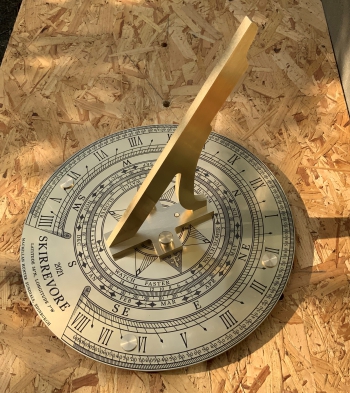
A replica lighthouse sundial made in naval brass and copied in detail from a similar one held in the National Museum of Scotland at Edinburgh.

Our replica lighthouse sundial is complete now. We handed it over to its new owner, who came to collect it from us in Edinburgh in September. “This is wonderful,” he said. “It is even better when I see it than I ever imagined. This sundial will go right in the centre of my lighthouse display.” Continue reading

Share:

Modern techniques for a replica sundial exhibit

A first trial assembly of the gnomon and base plate in position on the dial

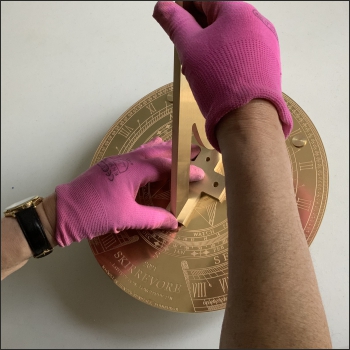
Details for making the sundial came from archive records and photos. This image shows the design and successful first assembly of the new parts.

The replica of a 19th century lighthouse sundial we are making will be part of a mobile exhibition. It is progressing well. Lighthouse sundials were made by skilled instrument makers, who worked mainly with hand tools. We are using modern techniques for cutting out the metal and etching the intricate design on the dial plate. The picture shows our first trial to assemble the dial and gnomon parts. Continue reading

Share:

Watch Scotland’s tallest sundial on TV with Susan Calman

Secret Scotland with Susan Calman at Glamis Castle sundial

Susan Calman chats with Alastair Hunter about the grand sundial at Glamis Castle and finds out how to read the time.

Susan Calman loves her tours of Scotland uncovering secrets for her Channel 5 TV series, ‘Secret Scotland with Susan Calman’. This time she was in Aberdeenshire and Angus. She began with a visit to Glamis Castle, the much-loved family home of Her Majesty the Queen Mother. Susan could not miss the chance to see Scotland’s tallest sundial while she was there, Continue reading

Share: