Sundial consulting

Sundial stones in a Scottish garden — the restoration

Ancient sundial pillar after restoration

A falling tree broke off the top of this pillar in Storm Arwen. The two sundial stones fell down to the ground. The pillar now has a new top section matched to the original stone. The sundial sections are clean and restored.

In November 2021, Storm Arwen caused serious damage with very strong winds especially in eastern Scotland. On one country estate an oak tree crashed onto this historic sundial in the family garden. It smashed the ancient pillar supporting the sundial stones. The family wanted to see the sundial fully restored. Continue reading

Share:

Sundial stones found in a Scottish garden — the cruciform stone

Cruciform sundial stone

The cruciform stone has four concave sides leaving four curving arms between them, thus creating the cross shape. This particular stone has a small concave end on each curving arm [not visible in the photo]. So the single stone has eight dials, on four large concave sides and four small ones. [Note: the shadow in this photo is from indoor lighting not from the sun.]

The cruciform type of sundial stone is a clever idea. During the day, as the sun moves round, each of the dials in turn will show a shadow and indicate the time. The straight dial edges cast the shadows. A cruciform stone can be on a lectern sundial but this one appears unique. Continue reading

Share:

Sundial stones discovered in a Scottish garden — the stone globe

Globe terminator stone sundial

The globe sundial will show light and dark sides of the stone in sunshine. The terminator line separates the two and the hour numbers show the time.

This stone globe was initially puzzling. It has a band of hour numerals and looks like a type of sundial. It is actually a globe terminator dial. The hour band lies parallel to earth’s equator, and the line between light and dark shadow in sunshine is the terminator. The puzzle was why the globe had a second sundial  stone fixed onto it, since removed in the workshop, as a later post will explain. Continue reading

Share:

Calibrating a new obelisk sundial in stone

Inclined test dial facing east

This dial stone is a test piece for the new obelisk sundial, and is on a board at the correct angle for one of the faces of the obelisk. It faces East and inclines 61° to horizontal so the shadow of the temporary plastic gnomon will show the time.

Obelisk sundials carved in stone were popular in Scotland in the 17th and 18th centuries. Quite recently stonemasons in Fife have done the work to carve a new obelisk sundial for one of their clients. Its dials have remained blank for mathematical calibration. Macmillan Hunter are responsible for the calibration and have supplied detailed dial instructions and drawings for the mason to use together with the required set of geometric bronze gnomons. Continue reading

Share:

North alignment on a Victorian pedestal

Sun direction measured with an angle finder

The direction of the sun measured against one edge of the octagonal stone pedestal using the angle finder and light slit

A Victorian sundial pedestal stands in the gardens of Riccarton estate outside Edinburgh. It once held a beautiful octagonal dial which is now in safe storage. A replacement dial is to go on show and it must be in a correct orientation. The gnomon on a sundial must point north. A wrong alignment will make the sundial inaccurate, and nothing on the 19th century pedestal actually marks the north. Continue reading

Share:

Historic Scottish Stone Sundial Restored

Scottish stone sundial restored

The octagonal base and baluster shaft support a carved cube stone. Before restoration the stones were covered in moss lying on the ground in the owner’s garden. The bronze horizontal dial is new.

Stone sundials were common in Scotland in the 17th and 18th centuries. They stood in the gardens of great houses, and in public places. The geometric form of the sundial would reflect the popular interests of the day in science and mathematics, and many displayed complex multiple dials. Originally this particular sundial may have belonged to a country estate near Falkirk. The present owner has had it for many years and in 2023 decided to restore it. Continue reading

Share:

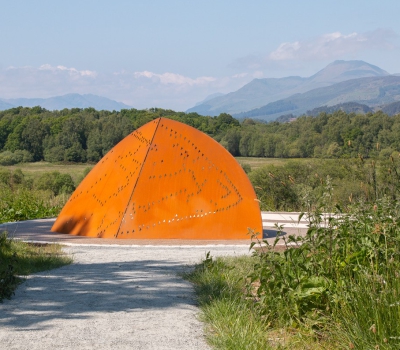
Skein of geese art installation at RSPB Loch Lomond

Skein of geese art installation at RSPB Loch Lomond

Skein Dial, Hannah Imlach, 2023. Art installation and sundial at RSPB Loch Lomond, with the artwork constructed in Corten steel in the foreground and the towering mass of Ben Lomond in the distance. This is a remarkable piece that captures the ephemeral impression of geese in flight and shows the dates when they migrate by a sundial shadow. Photo: Hannah Imlach

In November 2022 visual artist Hannah Imlach approached us to talk about an art installation she had in mind for the RSPB Nature Reserve at Loch Lomond. The reserve is a prime site where Greenland White-fronted geese come and overwinter. Hannah’s concept for her artwork was a visual image of skeins of geese flying in the sky combined with a sundial showing the times when the geese arrive and leave. White-fronted geese migrate from Greenland in the autumn and return there in the springtime to breed. Continue reading

Share:

Sundial memorial to Sir Sandford Fleming in Kirkcaldy

Sundial memorial to Sir Sandford Fleming

This is the analemmatic type of sundial that lies flat on the ground and the person casts the shadow to show the time.

The coastal trading and industrial town of Kirkcaldy in Fife, Scotland, was famous up to the 1960s for its linoleum. In an earlier age, Adam Smith the 18th century economist and author of The Wealth of Nations was born in the town. Sandford Fleming was born in Kirkcaldy on 7 January 1827. He pioneered the changes to standard time and time zones for the whole world. Continue reading

Share: