time

Inverkeithing Mercat Cross – sundial restoration complete

Inverkeithing Mercat Cross, the capital stone, cube sundial, and unicorn fully restored.

The Inverkeithing Mercat Cross is a tall stone column in the centre of the town. The capital stone, cube sundial, and unicorn sculpture are at the top of the column. There has been no ‘Cross’ as a Christian symbol on the column since the Reformation. Photo: Graciela Ainsworth.

The Inverkeithing Mercat Cross is a tall and handsome piece of historic town architecture. The Mercat Cross in Scottish towns was a symbol of licensed authority to trade in goods, and the trading place was at the Cross. The sundial would be a 17th century addition, now fully restored, together with the heraldic capital stone and the symbolic unicorn of Scotland.

The sundial is a cube stone which is ideal for a prominent place in a town. It is visible from all sides and it shows the time at all hours of the day. Continue reading

Share:

Haddo House cube stone sundial restored and reading solar time

Haddo House stone cube sundial

This sundial cube stone has fine carving detail. Each of five faces can read the time. The horizontal dial carved in the stone on top indicates an ornamental piece for a garden. A cube set on a tall pillar or on a wall will have the side dials only. Photo: Graciela Ainsworth.

This cube stone sundial stands in the garden of Haddo House, the National Trust for Scotland property in Aberdeenshire. When we examined it at the workshop, it had broken and missing gnomons and moss obscured the dials. After restoration the dials can now read solar time properly again.

A cube dial has the mathematical attraction of reading time by the sun on south, east, west, and north faces. As a result, as the sun moves round, the cube sundial is an excellent device for showing time Continue reading

Share:

Restoration of Inverkeithing Mercat Cross, finding true North

The azimuth sundial instrument

The azimuth sundial used as a measuring instrument for finding north. The cursor is set for the date, the cursor arm is turned to set the time. The gnomon shadow and cursor are in line.

The Mercat Cross at Inverkeithing in Scotland is a tall stone column that dates from the 14th century. The top of the column has a sundial stone in the form of a cube and a unicorn. Restoration of the whole column is now complete. To re-install the sundial stone correctly we had to find a true north line.

The north line is the direction that shadows will fall at noon, and Noon is the exact time of day when the sun is in the south. Continue reading

Share:

Sundial stones in a Scottish garden — the restoration

Ancient sundial pillar after restoration

A falling tree broke off the top of this pillar in Storm Arwen. The two sundial stones fell down to the ground. The pillar now has a new top section matched to the original stone. The sundial sections are clean and restored.

In November 2021, Storm Arwen caused serious damage with very strong winds especially in eastern Scotland. On one country estate an oak tree crashed onto this historic sundial in the family garden. It smashed the ancient pillar supporting the sundial stones. The family wanted to see the sundial fully restored. Continue reading

Share:

Sundial stones found in a Scottish garden — the cruciform stone

Cruciform sundial stone

The cruciform stone has four concave sides leaving four curving arms between them, thus creating the cross shape. This particular stone has a small concave end on each curving arm [not visible in the photo]. So the single stone has eight dials, on four large concave sides and four small ones. [Note: the shadow in this photo is from indoor lighting not from the sun.]

The cruciform type of sundial stone is a clever idea. During the day, as the sun moves round, each of the dials in turn will show a shadow and indicate the time. The straight dial edges cast the shadows. A cruciform stone can be on a lectern sundial but this one appears unique. Continue reading

Share:

Sundial stones discovered in a Scottish garden — the stone globe

Globe terminator stone sundial

The globe sundial will show light and dark sides of the stone in sunshine. The terminator line separates the two and the hour numbers show the time.

This stone globe was initially puzzling. It has a band of hour numerals and looks like a type of sundial. It is actually a globe terminator dial. The hour band lies parallel to earth’s equator, and the line between light and dark shadow in sunshine is the terminator. The puzzle was why the globe had a second sundial  stone fixed onto it, since removed in the workshop, as a later post will explain. Continue reading

Share:

A modern altitude sundial after Erasmus Habermel

A modern circular altitude sundial after Erasmus Habermel of Prague

Modern reconstruction of a 16th century altitude sundial for studying its mathematics and accuracy. An altitude dial uses the height of the sun to find the time. The dial is double-sided with the two half-years back-to-back.

Erasmus Habermel was a renowned scientific instrument maker working in the court of Emperor Rudolf II in Prague in the 16th century. He made instruments for all disciplines including astronomy and navigation. One of his sundials is an altitude dial in the clocks collection of the Augustine Museum in Freiburg im Bresgau*. It is an elegant circular dial and the mathematical construction is intriguing. Continue reading

Share:

Calibrating a new obelisk sundial in stone

Inclined test dial facing east

This dial stone is a test piece for the new obelisk sundial, and is on a board at the correct angle for one of the faces of the obelisk. It faces East and inclines 61° to horizontal so the shadow of the temporary plastic gnomon will show the time.

Obelisk sundials carved in stone were popular in Scotland in the 17th and 18th centuries. Quite recently stonemasons in Fife have done the work to carve a new obelisk sundial for one of their clients. Its dials have remained blank for mathematical calibration. Macmillan Hunter are responsible for the calibration and have supplied detailed dial instructions and drawings for the mason to use together with the required set of geometric bronze gnomons. Continue reading

Share:

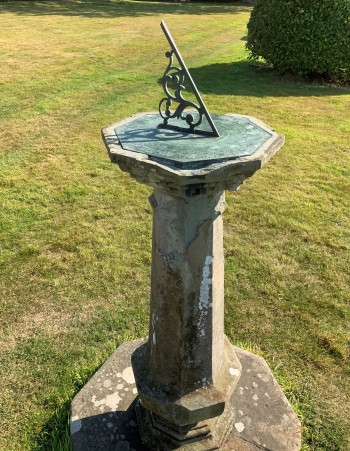
An 18th century horizontal garden sundial

A beautiful 18th century horizontal garden sundial

A historic horizontal bronze garden sundial, 1723

A fine 18th century horizontal sundial stands in the gardens of the House of Dun near Montrose. The dial is octagonal made in bronze set in a carved and moulded stone raised on a baluster pedestal and stone step. Elegant tracery scroll work supports the gnomon.

The dial engraving is detailed employing delicacy of variation in deep and light incisions and ornament. The chapter ring carries exact time divisions down to a single minute. Continue reading

Share:

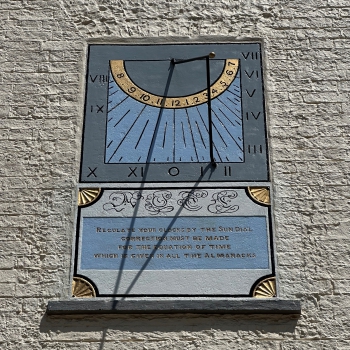
Wall sundial at Royal Square in St Helier, Jersey

Wall sundial at St Helier, Jersey

Wall sundial in Royal Square at St Helier, Jersey, Latitude 49.1839° N, Longitude 2.1057° W. The inscription reads: REGULATE YOUR CLOCKS BY THE SUN DIAL. CORRECTION MUST BE MADE FOR THE EQUATION OF TIME WHICH IS GIVEN IN ALL THE ALMANACKS.

This beautiful sundial is set into the wall of the old Picket House in Royal Square, St Helier, Jersey. Historical records show it was made by a talented Jerseyman called Elias Le Gros in the 1820s. In spite of being plastered over at one time by the military authorities and then restored again in 1875 after a public outcry over the dial’s obliteration, it is now in excellent condition, as our photo shows. Our host for lunch that day told us: “The dial is much admired but of course it isn’t accurate.” Poor old Elias Le Gros, now was the time to rescue his reputation! Continue reading

Share: