
GMT

Restoration of Inverkeithing Mercat Cross, finding true North

The azimuth sundial instrument

The azimuth sundial used as a measuring instrument for finding north. The cursor is set for the date, the cursor arm is turned to set the time. The gnomon shadow and cursor are in line.

The Mercat Cross at Inverkeithing in Scotland is a tall stone column that dates from the 14th century. The top of the column has a sundial stone in the form of a cube and a unicorn. Restoration of the whole column is now complete. To re-install the sundial stone correctly we had to find a true north line.

The north line is the direction that shadows will fall at noon, and Noon is the exact time of day when the sun is in the south. Continue reading
Share:

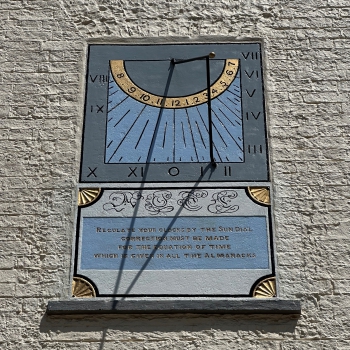
Wall sundial at Royal Square in St Helier, Jersey

Wall sundial at St Helier, Jersey

Wall sundial in Royal Square at St Helier, Jersey, Latitude 49.1839° N, Longitude 2.1057° W. The inscription reads: REGULATE YOUR CLOCKS BY THE SUN DIAL. CORRECTION MUST BE MADE FOR THE EQUATION OF TIME WHICH IS GIVEN IN ALL THE ALMANACKS.

This beautiful sundial is set into the wall of the old Picket House in Royal Square, St Helier, Jersey. Historical records show it was made by a talented Jerseyman called Elias Le Gros in the 1820s. In spite of being plastered over at one time by the military authorities and then restored again in 1875 after a public outcry over the dial’s obliteration, it is now in excellent condition, as our photo shows. Our host for lunch that day told us: “The dial is much admired but of course it isn’t accurate.” Poor old Elias Le Gros, now was the time to rescue his reputation! Continue reading

Share: