hour

Inverkeithing Mercat Cross – sundial restoration complete

Inverkeithing Mercat Cross, the capital stone, cube sundial, and unicorn fully restored.

The Inverkeithing Mercat Cross is a tall stone column in the centre of the town. The capital stone, cube sundial, and unicorn sculpture are at the top of the column. There has been no ‘Cross’ as a Christian symbol on the column since the Reformation. Photo: Graciela Ainsworth.

The Inverkeithing Mercat Cross is a tall and handsome piece of historic town architecture. The Mercat Cross in Scottish towns was a symbol of licensed authority to trade in goods, and the trading place was at the Cross. The sundial would be a 17th century addition, now fully restored, together with the heraldic capital stone and the symbolic unicorn of Scotland.

The sundial is a cube stone which is ideal for a prominent place in a town. It is visible from all sides and it shows the time at all hours of the day. Continue reading

Share:

Haddo House cube stone sundial restored and reading solar time

Haddo House stone cube sundial

This sundial cube stone has fine carving detail. Each of five faces can read the time. The horizontal dial carved in the stone on top indicates an ornamental piece for a garden. A cube set on a tall pillar or on a wall will have the side dials only. Photo: Graciela Ainsworth.

This cube stone sundial stands in the garden of Haddo House, the National Trust for Scotland property in Aberdeenshire. When we examined it at the workshop, it had broken and missing gnomons and moss obscured the dials. After restoration the dials can now read solar time properly again.

A cube dial has the mathematical attraction of reading time by the sun on south, east, west, and north faces. As a result, as the sun moves round, the cube sundial is an excellent device for showing time Continue reading

Share:

Restoration of Inverkeithing Mercat Cross, finding true North

The azimuth sundial instrument

The azimuth sundial used as a measuring instrument for finding north. The cursor is set for the date, the cursor arm is turned to set the time. The gnomon shadow and cursor are in line.

The Mercat Cross at Inverkeithing in Scotland is a tall stone column that dates from the 14th century. The top of the column has a sundial stone in the form of a cube and a unicorn. Restoration of the whole column is now complete. To re-install the sundial stone correctly we had to find a true north line.

The north line is the direction that shadows will fall at noon, and Noon is the exact time of day when the sun is in the south. Continue reading

Share:

Sundial stones found in a Scottish garden — the cruciform stone

Cruciform sundial stone

The cruciform stone has four concave sides leaving four curving arms between them, thus creating the cross shape. This particular stone has a small concave end on each curving arm [not visible in the photo]. So the single stone has eight dials, on four large concave sides and four small ones. [Note: the shadow in this photo is from indoor lighting not from the sun.]

The cruciform type of sundial stone is a clever idea. During the day, as the sun moves round, each of the dials in turn will show a shadow and indicate the time. The straight dial edges cast the shadows. A cruciform stone can be on a lectern sundial but this one appears unique. Continue reading

Share:

Sundial stones discovered in a Scottish garden — the stone globe

Globe terminator stone sundial

The globe sundial will show light and dark sides of the stone in sunshine. The terminator line separates the two and the hour numbers show the time.

This stone globe was initially puzzling. It has a band of hour numerals and looks like a type of sundial. It is actually a globe terminator dial. The hour band lies parallel to earth’s equator, and the line between light and dark shadow in sunshine is the terminator. The puzzle was why the globe had a second sundial  stone fixed onto it, since removed in the workshop, as a later post will explain. Continue reading

Share:

A design of azimuth sundial to go in a garden

Azimuth sundial on 10 October at 11.10am

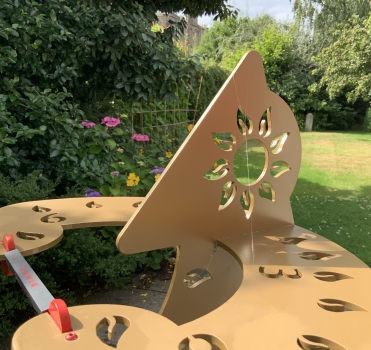
On 10 October the autumn equinox has passed and the cursor reading point has moved out from the inner circle of the dial towards winter solstice at the circumference. The sighting arm carries a short vertical gnomon which casts its shadow in line with the sun.

The azimuth sundial is an intriguing instrument. It finds the time from the direction of the sun. This idea sounds simple, the sun rises in the East, at Noon it is due South, and it sets again in the West, but it is complicated by the time of year. This note is about a new design for a precision azimuth sundial to go in a garden. Continue reading

Share:

A sundial commission unwrapped for an 80th birthday celebration

A sundial commission for an 80th birthday celebration

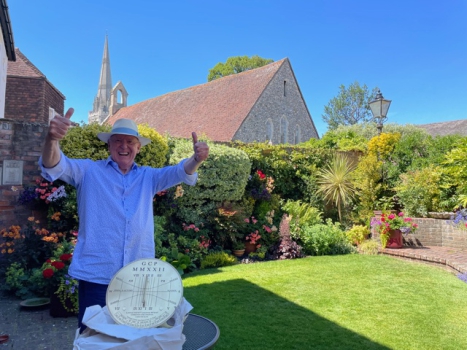
The design is a polar sundial, which tilts up at the latitude angle. The happy owner has unwrapped his 80th birthday present from the family.

“My father turns 80 this year and we are looking to commission a sundial in celebration. Is this possible? What’s the process? How long does it take?” When this email appeared in our inbox one day in March of course we wanted to follow it up. It sounded such a lovely suggestion from the family. Later when we learned a little more it looked like a perfect plan. Continue reading

Share:

Accurate Solar Time Sundial Installed in a North London Garden

Accurate Solar Time sundial installed and set up at the exact time of local Noon

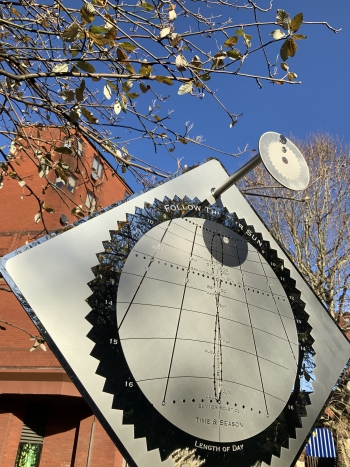
The sundial is in our client’s garden in North London. The sundial faces due south. We set it up at Noon on 28 November, using accurate corrections for the Equation of Time and local Longitude. The photo shows Solar Time at 12.30pm.

The world of solar time has fascinating ideas to explore. Our accurate sundial is almost a compendium of what a sundial can do. The client’s wish was something special for their newly created garden, and our design of a vertical sundial display appealed to them. Continue reading

Share:

Rustic stone sundial in an Edinburgh garden

A stone sundial carved in rustic style for an Edinburgh garden

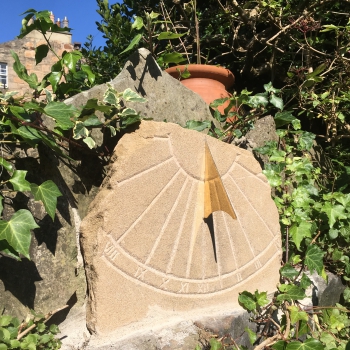
This sundial is delightful. It is the first piece of work by someone in Edinburgh who is learning to do stone carving. It is a very good sundial and they should be proud.

A sundial carved in stone is always special. This sundial is the first piece of work by a stone carver who has begun learning the craft of carving for their own pleasure. The result is very good. The rustic design suits the sunny spot on their slightly overgrown wall in the garden in Edinburgh so well.

Even a rustic design has to follow the sundial rules for the angles of lines on the dial and the angle of slope of the gnomon. Continue reading

Share:

The impossible Dihelion sundial photo

The impossible Dihelion sundial photo

We shot this impossible photo blind because there is no room to stand between the sundial and the house wall.

Dihelion is our well-known dual sundial design, which reads solar time and solar declination. It is impossible to take this photo in the normal way because the sundial is too close to the house, and there is nowhere to stand. So the photo was taken by holding the camera against the house and shooting blind. At a first attempt, the picture has turned out well. Continue reading

Share: