sundial restoration

Inverkeithing Mercat Cross – sundial restoration complete

Inverkeithing Mercat Cross, the capital stone, cube sundial, and unicorn fully restored.

The Inverkeithing Mercat Cross is a tall stone column in the centre of the town. The capital stone, cube sundial, and unicorn sculpture are at the top of the column. There has been no ‘Cross’ as a Christian symbol on the column since the Reformation. Photo: Graciela Ainsworth.

The Inverkeithing Mercat Cross is a tall and handsome piece of historic town architecture. The Mercat Cross in Scottish towns was a symbol of licensed authority to trade in goods, and the trading place was at the Cross. The sundial would be a 17th century addition, now fully restored, together with the heraldic capital stone and the symbolic unicorn of Scotland.

The sundial is a cube stone which is ideal for a prominent place in a town. It is visible from all sides and it shows the time at all hours of the day. Continue reading

Share:

Butterton church sundial and memorial brass from Tideswell

Butterton Church sundial restored

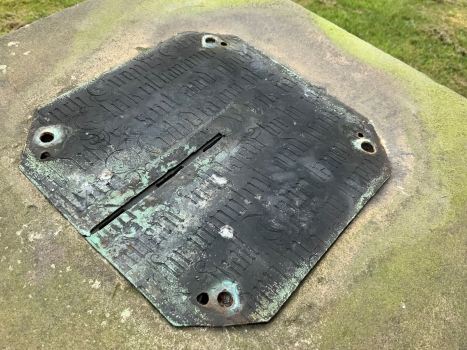
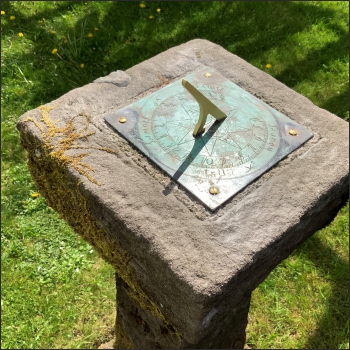
The Butterton church sundial has a new brass gnomon on the old dial plate. After many years outdoors the brass plate has turned green in colour. The Gothic script on the back of the plate shows it came from the Pursglove memorial in Tideswell church.

A few years ago we restored the sundial at St Bartholomew’s Church in the lovely Staffordshire village of Butterton. We found that the brass dial plate had ancient engraving in Gothic script on the underside, which was a mystery. The writing looked like part of a memorial brass, and we now know it came from Tideswell church in Derbyshire. Continue reading

Share:

Sundial stones in a Scottish garden — the restoration

Ancient sundial pillar after restoration

A falling tree broke off the top of this pillar in Storm Arwen. The two sundial stones fell down to the ground. The pillar now has a new top section matched to the original stone. The sundial sections are clean and restored.

In November 2021, Storm Arwen caused serious damage with very strong winds especially in eastern Scotland. On one country estate an oak tree crashed onto this historic sundial in the family garden. It smashed the ancient pillar supporting the sundial stones. The family wanted to see the sundial fully restored. Continue reading

Share:

Historic Scottish Stone Sundial Restored

Scottish stone sundial restored

The octagonal base and baluster shaft support a carved cube stone. Before restoration the stones were covered in moss lying on the ground in the owner’s garden. The bronze horizontal dial is new.

Stone sundials were common in Scotland in the 17th and 18th centuries. They stood in the gardens of great houses, and in public places. The geometric form of the sundial would reflect the popular interests of the day in science and mathematics, and many displayed complex multiple dials. Originally this particular sundial may have belonged to a country estate near Falkirk. The present owner has had it for many years and in 2023 decided to restore it. Continue reading

Share:

A first sight of the sundial at Lews Castle

A first sight of the Lews Castle sundial

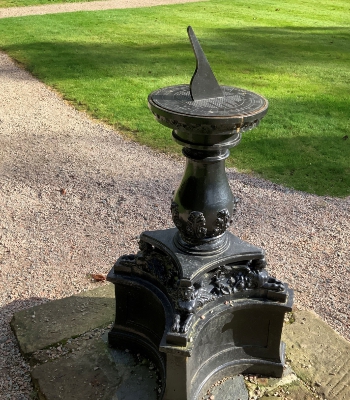
A first sight of the Lews Castle sundial at Stornoway, Isle of Lewis. This was a restoration we completed in 2020.

The sundial at Lews Castle, which overlooks Stornoway harbour on the Isle of Lewis, Scotland, is a restoration of a piece of nineteenth century garden furniture. The cast iron pedestal was once the base of a water fountain that stood in the castle grounds. In 2019 work started on a major Castle Grounds Regeneration Project, which included the pedestal. This ornate piece would be restored as a sundial. The Stornoway Trust had a special wish to see a timeline history of the Lews estate written on the dial. Continue reading

Share:

Sundial restoration at Butterton church turns up a mystery engraving

Brass sundial plate turned over and showing engraved writing on the back

The engraving looks like Gothic script but we didn’t know how to read it. We do hope to learn more about this extraordinary discovery on the back of a brass sundial. So far it has proved a mystery.

The Church of St Bartholomew in the lovely Staffordshire village of Butterton in the Peak District stands on high ground. Its tall spire is visible for miles around. Just near the church’s south porch there is a sundial. The sundial pedestal may once have been part of a medieval stone cross, and the dial made of brass Continue reading

Share:

Restoration of a small brass garden sundial from the 1930s

Brass sundial from the 1930s restored with a new gnomonThis small brass garden sundial had lost its gnomon. It is dearly loved by its owner who has known it since childhood, and she wanted to have it restored. As often happens at different times the family moved home and the sundial moved too. Continue reading
Share:

Restoration of an Atlas figure armillary sundial

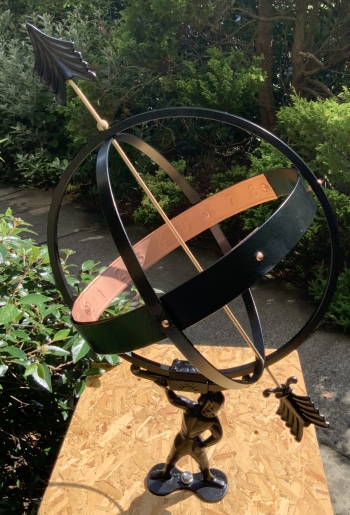
Armillary sundial and Atlas figure after restoration

After years of gradual deterioration outdoors the sundial was in poor condition. The Atlas figure was hard to recognise. This is an Art Deco design from the 1930’s. It has now come back to life as a working armillary sundial after complete restoration.

This armillary sundial was once in poor condition. It had been outside in the garden for a long time, and the owners asked us to restore it for them. The Atlas figure that supports the rings, and the arrowhead and tail, were badly tarnished. Continue reading

Share:

New Sundial for Lews Castle at Stornoway, Isle of Lewis

New sundial for the cast iron pedestal found at Lews Castle, Stornoway

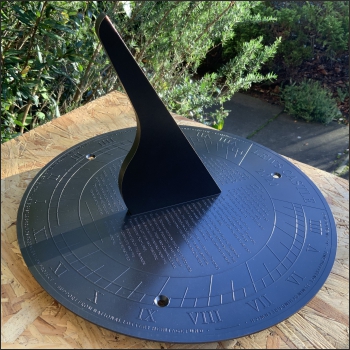
The new sundial explains the history of Lews Castle. It will be installed in the sunken garden as part of a regeneration project.

Lews Castle at Stornoway on the Isle of Lewis in the Western Isles is in the far north of Scotland. It once belonged to the wealthy overseas trader Sir James Matheson, who built the castle as a mansion home on the site of the ancient Seaforth Lodge in the 1840s. He planted woodlands to surround his property and laid out pleasure gardens with species imported from all over the world. An extensive programme of work to regenerate the castle grounds began in 2019. When an original cast iron pedestal was discovered at the castle it was decided it should be restored. It now has a new sundial, which is just finished, and Continue reading

Share:

Restoration of the obelisk sundial at Drummond Castle gardens

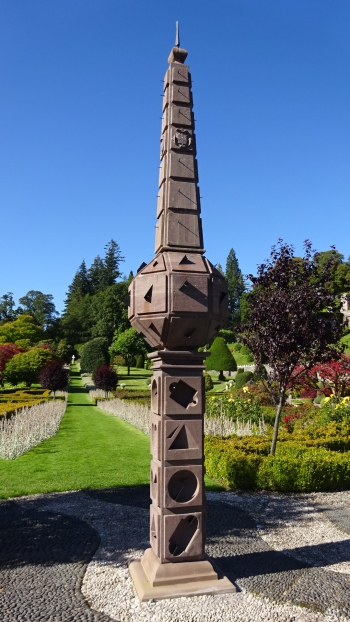
THE DRUMMOND CASTLE OBELISK SUNDIAL

The sundial consists of 61 multiple dials on raised panels and in sunken hollows. The date of the sundial is 1630. It has been made as an exhibition piece to show all of the sundial mathematics of its era.

The sundial obelisk at Drummond Castle in Perthshire has a long and distinguished history. It has its place in the architecture of the ancient castles and houses in Scotland. It is connected with the very earliest days of the British Sundial Society (BSS). And it is one of the most important free-standing sundials in the British Isles from the early 1600s still surviving.

In 2017 after almost four hundred years outdoors the sundial was showing serious signs of the stone deteriorating. The whole structure was feared to be unsound. Making it safe had become urgent. Continue reading

Share: