gnomon

A study of sundial calibration for eight selected altitude dials

Mathematical diagrams for the circular altitude dial.

This dial has circular graduations for dates. The gnomon is fixed, and the hour point on a circle is where the nodus shadow falls. A series of calculations for coordinates (X’, Y’) give the calibration for the whole dial. These calculations are by numerical iteration on computer.

Altitude dials are an intriguing type of sundial. There are many individual types, and they mainly date from around the 1600s or earlier. Our own design for a full-scale altitude sundial for the garden is a circular dial. It follows the same working principle as a circular brass dial in The Augustine Museum in Germany. We decided to investigate the calibration of eight different altitude dials, including the one from the museum, and we have now completed a study of their mathematics. We submit the report of our study in full for wider interest here: A Study of Altitude Sundial Calibration.


Share:

A circular altitude sundial at full-scale for the garden

Altitude sundial in the garden

The altitude sundial in sunshine on 21st July 2026. The dial reads 3:50 pm, which is only 4 minutes difference from clock time, with corrections made for BST, Longitude, and EOT. The reading point is the tip of the shadow, which is the shadow of the gnomon nodus. 

The altitude sundial is an intriguing instrument. It relies on measuring the height of the sun to tell the time. It also requires the user to adjust for the time of year before making a reading. There are many altitude sundials and there is one particular one with a circular dial, from around the year 1600, which we find very interesting. We have now designed and built one like it at full-scale for the garden. Continue reading

Share:

Inverkeithing Mercat Cross – sundial restoration complete

Inverkeithing Mercat Cross, the capital stone, cube sundial, and unicorn fully restored.

The Inverkeithing Mercat Cross is a tall stone column in the centre of the town. The capital stone, cube sundial, and unicorn sculpture are at the top of the column. There has been no ‘Cross’ as a Christian symbol on the column since the Reformation. Photo: Graciela Ainsworth.

The Inverkeithing Mercat Cross is a tall and handsome piece of historic town architecture. The Mercat Cross in Scottish towns was a symbol of licensed authority to trade in goods, and the trading place was at the Cross. The sundial would be a 17th century addition, now fully restored, together with the heraldic capital stone and the symbolic unicorn of Scotland.

The sundial is a cube stone which is ideal for a prominent place in a town. It is visible from all sides and it shows the time at all hours of the day. Continue reading

Share:

Haddo House cube stone sundial restored and reading solar time

Haddo House stone cube sundial

This sundial cube stone has fine carving detail. Each of five faces can read the time. The horizontal dial carved in the stone on top indicates an ornamental piece for a garden. A cube set on a tall pillar or on a wall will have the side dials only. Photo: Graciela Ainsworth.

This cube stone sundial stands in the garden of Haddo House, the National Trust for Scotland property in Aberdeenshire. When we examined it at the workshop, it had broken and missing gnomons and moss obscured the dials. After restoration the dials can now read solar time properly again.

A cube dial has the mathematical attraction of reading time by the sun on south, east, west, and north faces. As a result, as the sun moves round, the cube sundial is an excellent device for showing time Continue reading

Share:

A design of azimuth sundial to go in a garden

Azimuth sundial on 10 October at 11.10am

On 10 October the autumn equinox has passed and the cursor reading point has moved out from the inner circle of the dial towards winter solstice at the circumference. The sighting arm carries a short vertical gnomon which casts its shadow in line with the sun.

The azimuth sundial is an intriguing instrument. It finds the time from the direction of the sun. This idea sounds simple, the sun rises in the East, at Noon it is due South, and it sets again in the West, but it is complicated by the time of year. This note is about a new design for a precision azimuth sundial to go in a garden. Continue reading

Share:

Armillary sundial on the day of autumn equinox at noon

Armillary sundial on the day of the autumn equinox at noon

Every day at noon the gnomon rod casts its shadow on the centre line of the meridian band. When the day of spring or autumn equinox arrives the two orb balls cast a double shadow onto the meridian band. Away from the equinox, only one orb shadow will show.

Our armillary sundial casts distinctive shadows at noon on the day of autumn equinox, as seen in the photo. Its unique design allows the noon shadow of the gnomon rod to fall on the broad meridian band at its centre line. The two orb balls also cast their noon shadow onto the meridian band. Continue reading

Share:

Calibrating a new obelisk sundial in stone

Inclined test dial facing east

This dial stone is a test piece for the new obelisk sundial, and is on a board at the correct angle for one of the faces of the obelisk. It faces East and inclines 61° to horizontal so the shadow of the temporary plastic gnomon will show the time.

Obelisk sundials carved in stone were popular in Scotland in the 17th and 18th centuries. Quite recently stonemasons in Fife have done the work to carve a new obelisk sundial for one of their clients. Its dials have remained blank for mathematical calibration. Macmillan Hunter are responsible for the calibration and have supplied detailed dial instructions and drawings for the mason to use together with the required set of geometric bronze gnomons. Continue reading

Share:

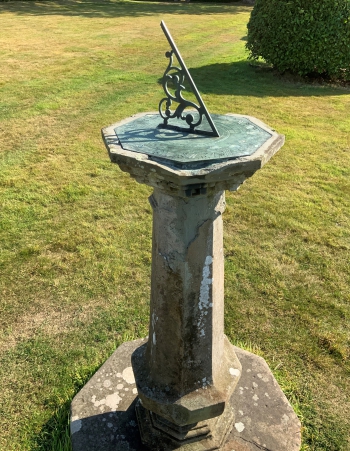
North alignment on a Victorian pedestal

Sun direction measured with an angle finder

The direction of the sun measured against one edge of the octagonal stone pedestal using the angle finder and light slit

A Victorian sundial pedestal stands in the gardens of Riccarton estate outside Edinburgh. It once held a beautiful octagonal dial which is now in safe storage. A replacement dial is to go on show and it must be in a correct orientation. The gnomon on a sundial must point north. A wrong alignment will make the sundial inaccurate, and nothing on the 19th century pedestal actually marks the north. Continue reading

Share:

An 18th century horizontal garden sundial

A beautiful 18th century horizontal garden sundial

A historic horizontal bronze garden sundial, 1723

A fine 18th century horizontal sundial stands in the gardens of the House of Dun near Montrose. The dial is octagonal made in bronze set in a carved and moulded stone raised on a baluster pedestal and stone step. Elegant tracery scroll work supports the gnomon.

The dial engraving is detailed employing delicacy of variation in deep and light incisions and ornament. The chapter ring carries exact time divisions down to a single minute. Continue reading

Share:

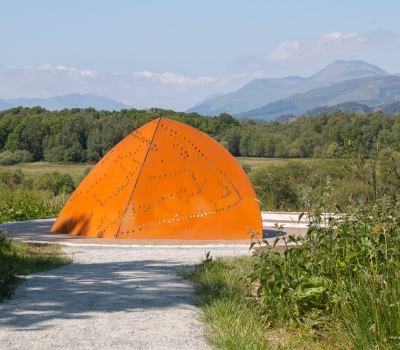
Skein of geese art installation at RSPB Loch Lomond

Skein of geese art installation at RSPB Loch Lomond

Skein Dial, Hannah Imlach, 2023. Art installation and sundial at RSPB Loch Lomond, with the artwork constructed in Corten steel in the foreground and the towering mass of Ben Lomond in the distance. This is a remarkable piece that captures the ephemeral impression of geese in flight and shows the dates when they migrate by a sundial shadow. Photo: Hannah Imlach

In November 2022 visual artist Hannah Imlach approached us to talk about an art installation she had in mind for the RSPB Nature Reserve at Loch Lomond. The reserve is a prime site where Greenland White-fronted geese come and overwinter. Hannah’s concept for her artwork was a visual image of skeins of geese flying in the sky combined with a sundial showing the times when the geese arrive and leave. White-fronted geese migrate from Greenland in the autumn and return there in the springtime to breed. Continue reading

Share: