Scottish sundial

Inverkeithing Mercat Cross – sundial restoration complete

Inverkeithing Mercat Cross, the capital stone, cube sundial, and unicorn fully restored.

The Inverkeithing Mercat Cross is a tall stone column in the centre of the town. The capital stone, cube sundial, and unicorn sculpture are at the top of the column. There has been no ‘Cross’ as a Christian symbol on the column since the Reformation. Photo: Graciela Ainsworth.

The Inverkeithing Mercat Cross is a tall and handsome piece of historic town architecture. The Mercat Cross in Scottish towns was a symbol of licensed authority to trade in goods, and the trading place was at the Cross. The sundial would be a 17th century addition, now fully restored, together with the heraldic capital stone and the symbolic unicorn of Scotland.

The sundial is a cube stone which is ideal for a prominent place in a town. It is visible from all sides and it shows the time at all hours of the day. Continue reading

Share:

Sundial stones in a Scottish garden — the restoration

Ancient sundial pillar after restoration

A falling tree broke off the top of this pillar in Storm Arwen. The two sundial stones fell down to the ground. The pillar now has a new top section matched to the original stone. The sundial sections are clean and restored.

In November 2021, Storm Arwen caused serious damage with very strong winds especially in eastern Scotland. On one country estate an oak tree crashed onto this historic sundial in the family garden. It smashed the ancient pillar supporting the sundial stones. The family wanted to see the sundial fully restored. Continue reading

Share:

Sundial stones discovered in a Scottish garden — the stone globe

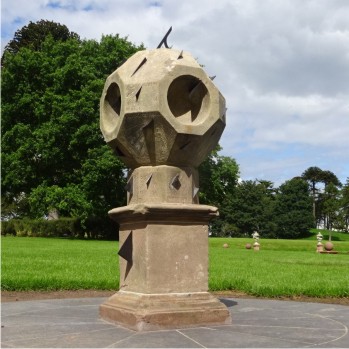
Globe terminator stone sundial

The globe sundial will show light and dark sides of the stone in sunshine. The terminator line separates the two and the hour numbers show the time.

This stone globe was initially puzzling. It has a band of hour numerals and looks like a type of sundial. It is actually a globe terminator dial. The hour band lies parallel to earth’s equator, and the line between light and dark shadow in sunshine is the terminator. The puzzle was why the globe had a second sundial  stone fixed onto it, since removed in the workshop, as a later post will explain. Continue reading

Share:

Historic Scottish Stone Sundial Restored

Scottish stone sundial restored

The octagonal base and baluster shaft support a carved cube stone. Before restoration the stones were covered in moss lying on the ground in the owner’s garden. The bronze horizontal dial is new.

Stone sundials were common in Scotland in the 17th and 18th centuries. They stood in the gardens of great houses, and in public places. The geometric form of the sundial would reflect the popular interests of the day in science and mathematics, and many displayed complex multiple dials. Originally this particular sundial may have belonged to a country estate near Falkirk. The present owner has had it for many years and in 2023 decided to restore it. Continue reading

Share:

Supreme Scottish Sundial at Glamis Castle

Sundial at Glamis Castle with 80 dials on the polyhedron

The polyhedron is an upper part of the sundial with 80 dials, and an earl’s coronet on top. Four lion sculptures at a lower level carry dials in their claws.

In the extraordinary world of Scottish historic sundials, the supreme sundial monument stands at Glamis Castle. It is the tallest and grandest sundial and is in the grounds of one of the most beautiful castles in Scotland. In August 2020 a TV crew were filming there for a future series. They asked Alastair Hunter to Continue reading

Share:

Restoration of the obelisk sundial at Drummond Castle gardens

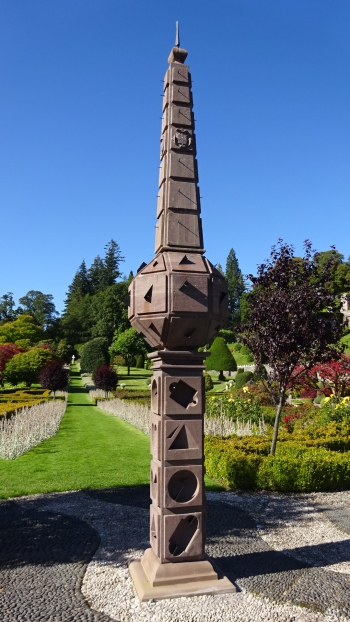
THE DRUMMOND CASTLE OBELISK SUNDIAL

The sundial consists of 61 multiple dials on raised panels and in sunken hollows. The date of the sundial is 1630. It has been made as an exhibition piece to show all of the sundial mathematics of its era.

The sundial obelisk at Drummond Castle in Perthshire has a long and distinguished history. It has its place in the architecture of the ancient castles and houses in Scotland. It is connected with the very earliest days of the British Sundial Society (BSS). And it is one of the most important free-standing sundials in the British Isles from the early 1600s still surviving.

In 2017 after almost four hundred years outdoors the sundial was showing serious signs of the stone deteriorating. The whole structure was feared to be unsound. Making it safe had become urgent. Continue reading

Share:

Restoration of a multi-faceted Scottish stone sundial

Sundial restoration in Scotland

Multi-faceted stone sundial after restoration. There are 34 separate dials, two for local time and the others for different places round the world.

Restoration of ancient stone sundials in Scotland can be very successful. As a latest example, a multi-faceted sundial at Nunraw, East Lothian, was found in poor condition in the garden of a private estate where it stands. It has now been restored to full working order and looks spectacular. The restoration was completed in June 2019.

This sundial belongs to the great era of Scottish sundials in the 17th and 18th centuries. It consists of three multi-faceted stones with a total of 34 separate dials. Continue reading

Share: