shadow

Restoration of Inverkeithing Mercat Cross, finding true North

The azimuth sundial instrument

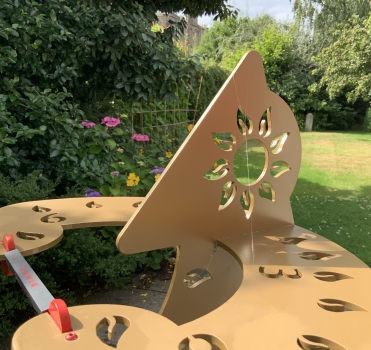
The azimuth sundial used as a measuring instrument for finding north. The cursor is set for the date, the cursor arm is turned to set the time. The gnomon shadow and cursor are in line.

The Mercat Cross at Inverkeithing in Scotland is a tall stone column that dates from the 14th century. The top of the column has a sundial stone in the form of a cube and a unicorn. Restoration of the whole column is now complete. To re-install the sundial stone correctly we had to find a true north line.

The north line is the direction that shadows will fall at noon, and Noon is the exact time of day when the sun is in the south. Continue reading

Share:

Sundial stones found in a Scottish garden — the cruciform stone

Cruciform sundial stone

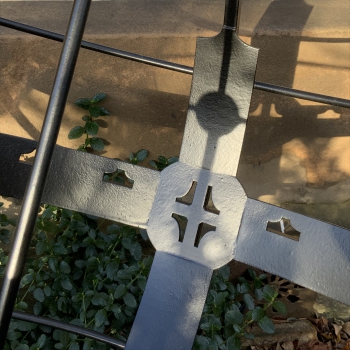
The cruciform stone has four concave sides leaving four curving arms between them, thus creating the cross shape. This particular stone has a small concave end on each curving arm [not visible in the photo]. So the single stone has eight dials, on four large concave sides and four small ones. [Note: the shadow in this photo is from indoor lighting not from the sun.]

The cruciform type of sundial stone is a clever idea. During the day, as the sun moves round, each of the dials in turn will show a shadow and indicate the time. The straight dial edges cast the shadows. A cruciform stone can be on a lectern sundial but this one appears unique. Continue reading

Share:

Sundial stones discovered in a Scottish garden — the stone globe

Globe terminator stone sundial

The globe sundial will show light and dark sides of the stone in sunshine. The terminator line separates the two and the hour numbers show the time.

This stone globe was initially puzzling. It has a band of hour numerals and looks like a type of sundial. It is actually a globe terminator dial. The hour band lies parallel to earth’s equator, and the line between light and dark shadow in sunshine is the terminator. The puzzle was why the globe had a second sundial  stone fixed onto it, since removed in the workshop, as a later post will explain. Continue reading

Share:

Armillary sundial on the day of autumn equinox at noon

Armillary sundial on the day of the autumn equinox at noon

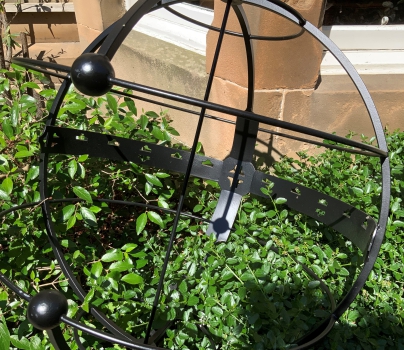
Every day at noon the gnomon rod casts its shadow on the centre line of the meridian band. When the day of spring or autumn equinox arrives the two orb balls cast a double shadow onto the meridian band. Away from the equinox, only one orb shadow will show.

Our armillary sundial casts distinctive shadows at noon on the day of autumn equinox, as seen in the photo. Its unique design allows the noon shadow of the gnomon rod to fall on the broad meridian band at its centre line. The two orb balls also cast their noon shadow onto the meridian band. Continue reading

Share:

Skein of geese art installation at RSPB Loch Lomond

Skein of geese art installation at RSPB Loch Lomond

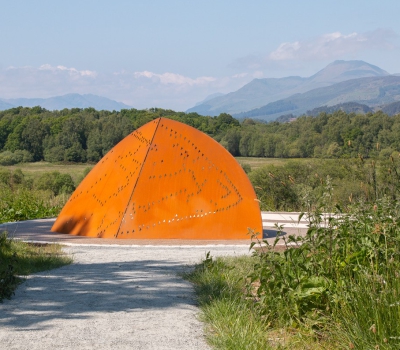
Skein Dial, Hannah Imlach, 2023. Art installation and sundial at RSPB Loch Lomond, with the artwork constructed in Corten steel in the foreground and the towering mass of Ben Lomond in the distance. This is a remarkable piece that captures the ephemeral impression of geese in flight and shows the dates when they migrate by a sundial shadow. Photo: Hannah Imlach

In November 2022 visual artist Hannah Imlach approached us to talk about an art installation she had in mind for the RSPB Nature Reserve at Loch Lomond. The reserve is a prime site where Greenland White-fronted geese come and overwinter. Hannah’s concept for her artwork was a visual image of skeins of geese flying in the sky combined with a sundial showing the times when the geese arrive and leave. White-fronted geese migrate from Greenland in the autumn and return there in the springtime to breed. Continue reading

Share:

Sundial memorial to Sir Sandford Fleming in Kirkcaldy

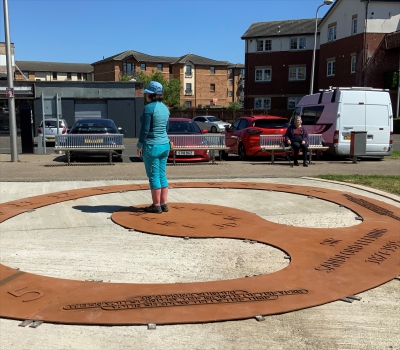
Sundial memorial to Sir Sandford Fleming

This is the analemmatic type of sundial that lies flat on the ground and the person casts the shadow to show the time.

The coastal trading and industrial town of Kirkcaldy in Fife, Scotland, was famous up to the 1960s for its linoleum. In an earlier age, Adam Smith the 18th century economist and author of The Wealth of Nations was born in the town. Sandford Fleming was born in Kirkcaldy on 7 January 1827. He pioneered the changes to standard time and time zones for the whole world. Continue reading

Share:

Armillary sundial reads summer solstice by the shadow of a ball at noon

At the summer solstice the armillary sundial casts a shadow of the ball at noon

At summer solstice the ball on the upper tropic ring casts its shadow exactly onto the opposite ring below. The upper tropical ring is the tropic of Cancer and lower ring is Capricorn.

The armillary sphere dates back to ancient times when astronomers created their own vision of the earth and the heavens. The idea still works today and our own design creates a sundial with a special feature of two balls that mark the passage of the seasons by their shadows. One of the balls reads summer solstice. This is the high point of the year when the sun is highest in the sky. Continue reading

Share:

Armillary sundial shadow one month on from winter solstice

Armillary sundial shadow one month on from winter solstice

The shadow of the ball on the sundial follows the sun all year round. The sun is low in the sky in winter, and it reaches its lowest point at the Winter Solstice on 21st December. This photo is one month later on 20th January. The sun is already higher in the sky, and the ball’s shadow has moved down.

Sundials catch a shadow from the sun. It is such a simple idea. The shadow on the sundial shows the sun’s position in the sky and the sundial reads it out as time, usually the time of day and often the time of year as well. Our armillary sundial is a special one with two balls that give the time of the year measured by the height of their shadow at noon. One ball casts a shadow in the winter months and the other one in summer. Continue reading

Share:

The impossible Dihelion sundial photo

The impossible Dihelion sundial photo

We shot this impossible photo blind because there is no room to stand between the sundial and the house wall.

Dihelion is our well-known dual sundial design, which reads solar time and solar declination. It is impossible to take this photo in the normal way because the sundial is too close to the house, and there is nowhere to stand. So the photo was taken by holding the camera against the house and shooting blind. At a first attempt, the picture has turned out well. Continue reading

Share:

New design of armillary sphere takes shape in Edinburgh

New design of armillary sphere taking shape

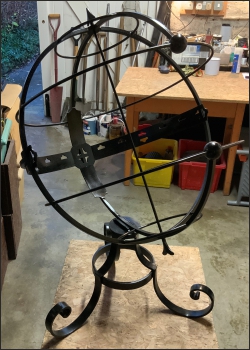
A new design of armillary sphere takes shape in Edinburgh, inspired by an original sundial from Northern Italy. The skilled blacksmith work is complete. This is a bespoke design with gold highlights still to be painted.

A new design of armillary sphere has been taking shape in Edinburgh. It is inspired by an original sundial from Northern Italy which has an attractive and distinctive form. The expert blacksmiths at Ratho Byres Forge have done an excellent job in working from our design. Continue reading

Share: