Sculpture

Inverkeithing Mercat Cross – sundial restoration complete

Inverkeithing Mercat Cross, the capital stone, cube sundial, and unicorn fully restored.

The Inverkeithing Mercat Cross is a tall stone column in the centre of the town. The capital stone, cube sundial, and unicorn sculpture are at the top of the column. There has been no ‘Cross’ as a Christian symbol on the column since the Reformation. Photo: Graciela Ainsworth.

The Inverkeithing Mercat Cross is a tall and handsome piece of historic town architecture. The Mercat Cross in Scottish towns was a symbol of licensed authority to trade in goods, and the trading place was at the Cross. The sundial would be a 17th century addition, now fully restored, together with the heraldic capital stone and the symbolic unicorn of Scotland.

The sundial is a cube stone which is ideal for a prominent place in a town. It is visible from all sides and it shows the time at all hours of the day. Continue reading

Share:

Sundial stones in a Scottish garden — the restoration

Ancient sundial pillar after restoration

A falling tree broke off the top of this pillar in Storm Arwen. The two sundial stones fell down to the ground. The pillar now has a new top section matched to the original stone. The sundial sections are clean and restored.

In November 2021, Storm Arwen caused serious damage with very strong winds especially in eastern Scotland. On one country estate an oak tree crashed onto this historic sundial in the family garden. It smashed the ancient pillar supporting the sundial stones. The family wanted to see the sundial fully restored. Continue reading

Share:

Sundial stones found in a Scottish garden — the cruciform stone

Cruciform sundial stone

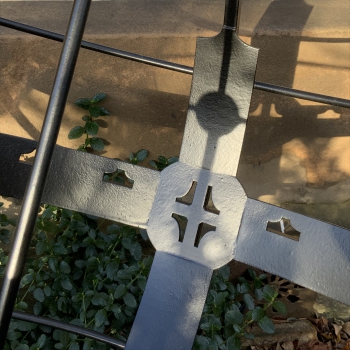
The cruciform stone has four concave sides leaving four curving arms between them, thus creating the cross shape. This particular stone has a small concave end on each curving arm [not visible in the photo]. So the single stone has eight dials, on four large concave sides and four small ones. [Note: the shadow in this photo is from indoor lighting not from the sun.]

The cruciform type of sundial stone is a clever idea. During the day, as the sun moves round, each of the dials in turn will show a shadow and indicate the time. The straight dial edges cast the shadows. A cruciform stone can be on a lectern sundial but this one appears unique. Continue reading

Share:

Sundial stones discovered in a Scottish garden — the stone globe

Globe terminator stone sundial

The globe sundial will show light and dark sides of the stone in sunshine. The terminator line separates the two and the hour numbers show the time.

This stone globe was initially puzzling. It has a band of hour numerals and looks like a type of sundial. It is actually a globe terminator dial. The hour band lies parallel to earth’s equator, and the line between light and dark shadow in sunshine is the terminator. The puzzle was why the globe had a second sundial  stone fixed onto it, since removed in the workshop, as a later post will explain. Continue reading

Share:

Looking for a place for our armillary sundial

Looking for a place for our armillary sundial

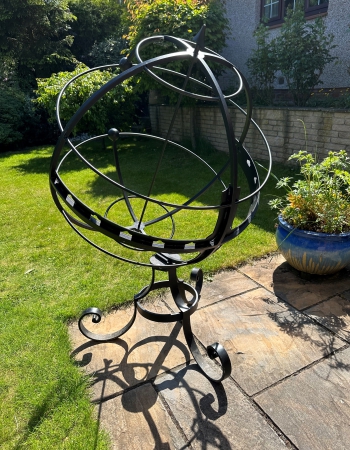
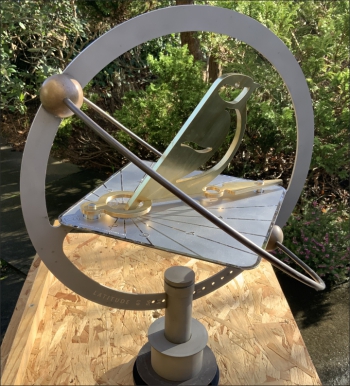
The armillary sundial captures the dynamics of the earth spinning on its axis and orbiting the sun. The equatorial band is pierced with markers for the hours. A meridian band shows the seasons.

Now that we have moved, we have been looking for a place for our armillary sundial. Before, it was nestling gently in its surroundings with plants in the garden growing up through the rings and wrapping themselves around. For the moment it is out in the open where  we can see it better. It has an air of almost floating on its stand with the lightness of the rings and the delicate shadows on the ground. Continue reading

Share:

Skein of geese art installation at RSPB Loch Lomond

Skein of geese art installation at RSPB Loch Lomond

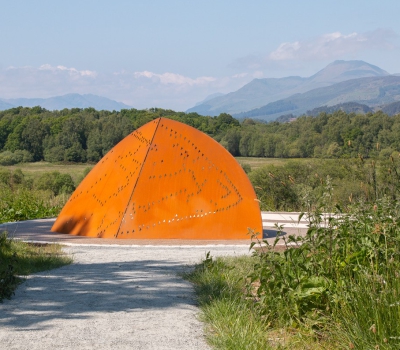
Skein Dial, Hannah Imlach, 2023. Art installation and sundial at RSPB Loch Lomond, with the artwork constructed in Corten steel in the foreground and the towering mass of Ben Lomond in the distance. This is a remarkable piece that captures the ephemeral impression of geese in flight and shows the dates when they migrate by a sundial shadow. Photo: Hannah Imlach

In November 2022 visual artist Hannah Imlach approached us to talk about an art installation she had in mind for the RSPB Nature Reserve at Loch Lomond. The reserve is a prime site where Greenland White-fronted geese come and overwinter. Hannah’s concept for her artwork was a visual image of skeins of geese flying in the sky combined with a sundial showing the times when the geese arrive and leave. White-fronted geese migrate from Greenland in the autumn and return there in the springtime to breed. Continue reading

Share:

The Sandford Fleming sundial memorial nears completion

The Sandford Fleming sundial memorial nears completion

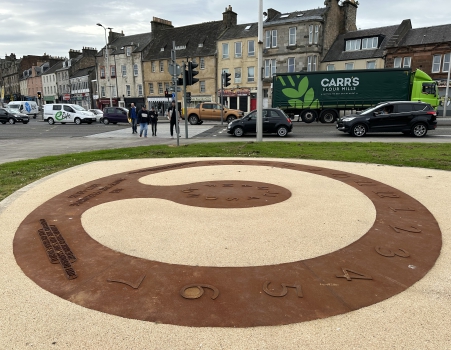
The Sandford Fleming sundial memorial nears completion now the paving is laid. The memorial is on Kirkcaldy waterfront at the end of the High Street.

The Sandford Fleming sundial memorial nears its final phase of completion. The bonded resin paving surface has now been laid. Its creamy colour sets off the brown Corten weathering steel of the sundial extremely well, and it frames the oval shape, which represents Sandford Fleming’s main idea of a system of time that embraces the whole of the world. The sundial is furnished with brief text panels for explanation, and a new information board is on its way.

Share:

Sundial memorial to Sir Sandford Fleming in Kirkcaldy

Sundial memorial to Sir Sandford Fleming

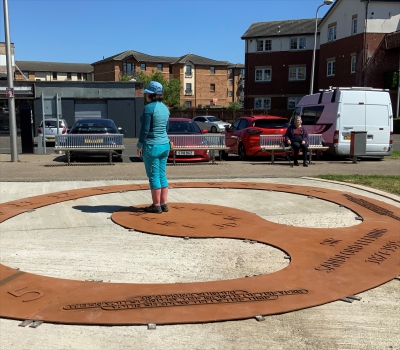
This is the analemmatic type of sundial that lies flat on the ground and the person casts the shadow to show the time.

The coastal trading and industrial town of Kirkcaldy in Fife, Scotland, was famous up to the 1960s for its linoleum. In an earlier age, Adam Smith the 18th century economist and author of The Wealth of Nations was born in the town. Sandford Fleming was born in Kirkcaldy on 7 January 1827. He pioneered the changes to standard time and time zones for the whole world. Continue reading

Share:

The last of our songbird sundials flies to Paris

Orbdial sundial design with songbird gnomon

This design is a form of universal sundial. It is adjustable and we build it for its intended latitude.

The last of our songbird sundials has flown away. It now has a new home in a new country, in Paris. This special design appeals to the eye and has intriguing gnomonic features. The new owner already knew that the Orbdial was the one they wanted. Continue reading

Share:

Armillary sundial shadow one month on from winter solstice

Armillary sundial shadow one month on from winter solstice

The shadow of the ball on the sundial follows the sun all year round. The sun is low in the sky in winter, and it reaches its lowest point at the Winter Solstice on 21st December. This photo is one month later on 20th January. The sun is already higher in the sky, and the ball’s shadow has moved down.

Sundials catch a shadow from the sun. It is such a simple idea. The shadow on the sundial shows the sun’s position in the sky and the sundial reads it out as time, usually the time of day and often the time of year as well. Our armillary sundial is a special one with two balls that give the time of the year measured by the height of their shadow at noon. One ball casts a shadow in the winter months and the other one in summer. Continue reading

Share: