design

Inverkeithing Mercat Cross – sundial restoration complete

Inverkeithing Mercat Cross, the capital stone, cube sundial, and unicorn fully restored.

The Inverkeithing Mercat Cross is a tall stone column in the centre of the town. The capital stone, cube sundial, and unicorn sculpture are at the top of the column. There has been no ‘Cross’ as a Christian symbol on the column since the Reformation. Photo: Graciela Ainsworth.

The Inverkeithing Mercat Cross is a tall and handsome piece of historic town architecture. The Mercat Cross in Scottish towns was a symbol of licensed authority to trade in goods, and the trading place was at the Cross. The sundial would be a 17th century addition, now fully restored, together with the heraldic capital stone and the symbolic unicorn of Scotland.

The sundial is a cube stone which is ideal for a prominent place in a town. It is visible from all sides and it shows the time at all hours of the day. Continue reading

Share:

Haddo House cube stone sundial restored and reading solar time

Haddo House stone cube sundial

This sundial cube stone has fine carving detail. Each of five faces can read the time. The horizontal dial carved in the stone on top indicates an ornamental piece for a garden. A cube set on a tall pillar or on a wall will have the side dials only. Photo: Graciela Ainsworth.

This cube stone sundial stands in the garden of Haddo House, the National Trust for Scotland property in Aberdeenshire. When we examined it at the workshop, it had broken and missing gnomons and moss obscured the dials. After restoration the dials can now read solar time properly again.

A cube dial has the mathematical attraction of reading time by the sun on south, east, west, and north faces. As a result, as the sun moves round, the cube sundial is an excellent device for showing time Continue reading

Share:

Sundial stones found in a Scottish garden — the cruciform stone

Cruciform sundial stone

The cruciform stone has four concave sides leaving four curving arms between them, thus creating the cross shape. This particular stone has a small concave end on each curving arm [not visible in the photo]. So the single stone has eight dials, on four large concave sides and four small ones. [Note: the shadow in this photo is from indoor lighting not from the sun.]

The cruciform type of sundial stone is a clever idea. During the day, as the sun moves round, each of the dials in turn will show a shadow and indicate the time. The straight dial edges cast the shadows. A cruciform stone can be on a lectern sundial but this one appears unique. Continue reading

Share:

A design of azimuth sundial to go in a garden

Azimuth sundial on 10 October at 11.10am

On 10 October the autumn equinox has passed and the cursor reading point has moved out from the inner circle of the dial towards winter solstice at the circumference. The sighting arm carries a short vertical gnomon which casts its shadow in line with the sun.

The azimuth sundial is an intriguing instrument. It finds the time from the direction of the sun. This idea sounds simple, the sun rises in the East, at Noon it is due South, and it sets again in the West, but it is complicated by the time of year. This note is about a new design for a precision azimuth sundial to go in a garden. Continue reading

Share:

Armillary sundial on the day of autumn equinox at noon

Armillary sundial on the day of the autumn equinox at noon

Every day at noon the gnomon rod casts its shadow on the centre line of the meridian band. When the day of spring or autumn equinox arrives the two orb balls cast a double shadow onto the meridian band. Away from the equinox, only one orb shadow will show.

Our armillary sundial casts distinctive shadows at noon on the day of autumn equinox, as seen in the photo. Its unique design allows the noon shadow of the gnomon rod to fall on the broad meridian band at its centre line. The two orb balls also cast their noon shadow onto the meridian band. Continue reading

Share:

Historic Scottish Stone Sundial Restored

Scottish stone sundial restored

The octagonal base and baluster shaft support a carved cube stone. Before restoration the stones were covered in moss lying on the ground in the owner’s garden. The bronze horizontal dial is new.

Stone sundials were common in Scotland in the 17th and 18th centuries. They stood in the gardens of great houses, and in public places. The geometric form of the sundial would reflect the popular interests of the day in science and mathematics, and many displayed complex multiple dials. Originally this particular sundial may have belonged to a country estate near Falkirk. The present owner has had it for many years and in 2023 decided to restore it. Continue reading

Share:

Looking for a place for our armillary sundial

Looking for a place for our armillary sundial

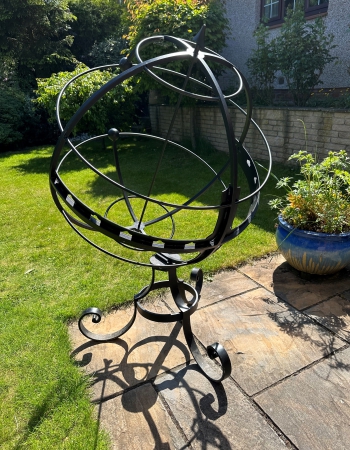
The armillary sundial captures the dynamics of the earth spinning on its axis and orbiting the sun. The equatorial band is pierced with markers for the hours. A meridian band shows the seasons.

Now that we have moved, we have been looking for a place for our armillary sundial. Before, it was nestling gently in its surroundings with plants in the garden growing up through the rings and wrapping themselves around. For the moment it is out in the open where  we can see it better. It has an air of almost floating on its stand with the lightness of the rings and the delicate shadows on the ground. Continue reading

Share:

Skein of geese art installation at RSPB Loch Lomond

Skein of geese art installation at RSPB Loch Lomond

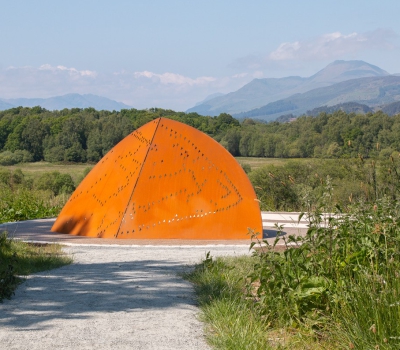
Skein Dial, Hannah Imlach, 2023. Art installation and sundial at RSPB Loch Lomond, with the artwork constructed in Corten steel in the foreground and the towering mass of Ben Lomond in the distance. This is a remarkable piece that captures the ephemeral impression of geese in flight and shows the dates when they migrate by a sundial shadow. Photo: Hannah Imlach

In November 2022 visual artist Hannah Imlach approached us to talk about an art installation she had in mind for the RSPB Nature Reserve at Loch Lomond. The reserve is a prime site where Greenland White-fronted geese come and overwinter. Hannah’s concept for her artwork was a visual image of skeins of geese flying in the sky combined with a sundial showing the times when the geese arrive and leave. White-fronted geese migrate from Greenland in the autumn and return there in the springtime to breed. Continue reading

Share:

A first sight of the sundial at Lews Castle

A first sight of the Lews Castle sundial

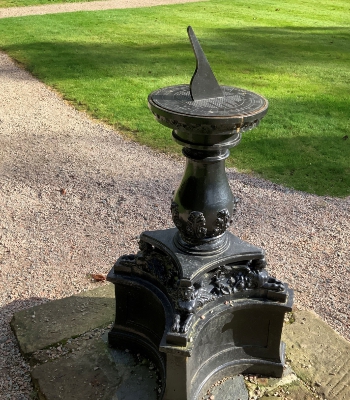
A first sight of the Lews Castle sundial at Stornoway, Isle of Lewis. This was a restoration we completed in 2020.

The sundial at Lews Castle, which overlooks Stornoway harbour on the Isle of Lewis, Scotland, is a restoration of a piece of nineteenth century garden furniture. The cast iron pedestal was once the base of a water fountain that stood in the castle grounds. In 2019 work started on a major Castle Grounds Regeneration Project, which included the pedestal. This ornate piece would be restored as a sundial. The Stornoway Trust had a special wish to see a timeline history of the Lews estate written on the dial. Continue reading

Share:

Sundial memorial to Sir Sandford Fleming in Kirkcaldy

Sundial memorial to Sir Sandford Fleming

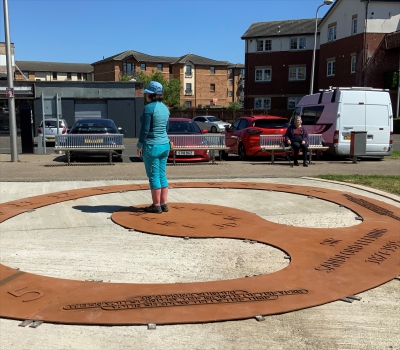
This is the analemmatic type of sundial that lies flat on the ground and the person casts the shadow to show the time.

The coastal trading and industrial town of Kirkcaldy in Fife, Scotland, was famous up to the 1960s for its linoleum. In an earlier age, Adam Smith the 18th century economist and author of The Wealth of Nations was born in the town. Sandford Fleming was born in Kirkcaldy on 7 January 1827. He pioneered the changes to standard time and time zones for the whole world. Continue reading

Share: