Sundial restoration

Sundial stones in a Scottish garden — the restoration

Ancient sundial pillar after restoration

A falling tree broke off the top of this pillar in Storm Arwen. The two sundial stones fell down to the ground. The pillar now has a new top section matched to the original stone. The sundial sections are clean and restored.

In November 2021, Storm Arwen caused serious damage with very strong winds especially in eastern Scotland. On one country estate an oak tree crashed onto this historic sundial in the family garden. It smashed the ancient pillar supporting the sundial stones. The family wanted to see the sundial fully restored. Continue reading

Share:

Sundial stones found in a Scottish garden — the cruciform stone

Cruciform sundial stone

The cruciform stone has four concave sides leaving four curving arms between them, thus creating the cross shape. This particular stone has a small concave end on each curving arm [not visible in the photo]. So the single stone has eight dials, on four large concave sides and four small ones. [Note: the shadow in this photo is from indoor lighting not from the sun.]

The cruciform type of sundial stone is a clever idea. During the day, as the sun moves round, each of the dials in turn will show a shadow and indicate the time. The straight dial edges cast the shadows. A cruciform stone can be on a lectern sundial but this one appears unique. Continue reading

Share:

Sundial stones discovered in a Scottish garden — the stone globe

Globe terminator stone sundial

The globe sundial will show light and dark sides of the stone in sunshine. The terminator line separates the two and the hour numbers show the time.

This stone globe was initially puzzling. It has a band of hour numerals and looks like a type of sundial. It is actually a globe terminator dial. The hour band lies parallel to earth’s equator, and the line between light and dark shadow in sunshine is the terminator. The puzzle was why the globe had a second sundial  stone fixed onto it, since removed in the workshop, as a later post will explain. Continue reading

Share:

North alignment on a Victorian pedestal

Sun direction measured with an angle finder

The direction of the sun measured against one edge of the octagonal stone pedestal using the angle finder and light slit

A Victorian sundial pedestal stands in the gardens of Riccarton estate outside Edinburgh. It once held a beautiful octagonal dial which is now in safe storage. A replacement dial is to go on show and it must be in a correct orientation. The gnomon on a sundial must point north. A wrong alignment will make the sundial inaccurate, and nothing on the 19th century pedestal actually marks the north. Continue reading

Share:

Historic Scottish Stone Sundial Restored

Scottish stone sundial restored

The octagonal base and baluster shaft support a carved cube stone. Before restoration the stones were covered in moss lying on the ground in the owner’s garden. The bronze horizontal dial is new.

Stone sundials were common in Scotland in the 17th and 18th centuries. They stood in the gardens of great houses, and in public places. The geometric form of the sundial would reflect the popular interests of the day in science and mathematics, and many displayed complex multiple dials. Originally this particular sundial may have belonged to a country estate near Falkirk. The present owner has had it for many years and in 2023 decided to restore it. Continue reading

Share:

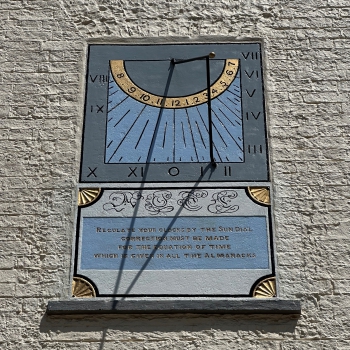
Wall sundial at Royal Square in St Helier, Jersey

Wall sundial at St Helier, Jersey

Wall sundial in Royal Square at St Helier, Jersey, Latitude 49.1839° N, Longitude 2.1057° W. The inscription reads: REGULATE YOUR CLOCKS BY THE SUN DIAL. CORRECTION MUST BE MADE FOR THE EQUATION OF TIME WHICH IS GIVEN IN ALL THE ALMANACKS.

This beautiful sundial is set into the wall of the old Picket House in Royal Square, St Helier, Jersey. Historical records show it was made by a talented Jerseyman called Elias Le Gros in the 1820s. In spite of being plastered over at one time by the military authorities and then restored again in 1875 after a public outcry over the dial’s obliteration, it is now in excellent condition, as our photo shows. Our host for lunch that day told us: “The dial is much admired but of course it isn’t accurate.” Poor old Elias Le Gros, now was the time to rescue his reputation! Continue reading

Share:

A first sight of the sundial at Lews Castle

A first sight of the Lews Castle sundial

A first sight of the Lews Castle sundial at Stornoway, Isle of Lewis. This was a restoration we completed in 2020.

The sundial at Lews Castle, which overlooks Stornoway harbour on the Isle of Lewis, Scotland, is a restoration of a piece of nineteenth century garden furniture. The cast iron pedestal was once the base of a water fountain that stood in the castle grounds. In 2019 work started on a major Castle Grounds Regeneration Project, which included the pedestal. This ornate piece would be restored as a sundial. The Stornoway Trust had a special wish to see a timeline history of the Lews estate written on the dial. Continue reading

Share:

Sundial restoration at Butterton church turns up a mystery engraving

Brass sundial plate turned over and showing engraved writing on the back

The engraving looks like Gothic script but we didn’t know how to read it. We do hope to learn more about this extraordinary discovery on the back of a brass sundial. So far it has proved a mystery.

The Church of St Bartholomew in the lovely Staffordshire village of Butterton in the Peak District stands on high ground. Its tall spire is visible for miles around. Just near the church’s south porch there is a sundial. The sundial pedestal may once have been part of a medieval stone cross, and the dial made of brass Continue reading

Share:

Restoration of a small brass garden sundial from the 1930s

Brass sundial from the 1930s restored with a new gnomonThis small brass garden sundial had lost its gnomon. It is dearly loved by its owner who has known it since childhood, and she wanted to have it restored. As often happens at different times the family moved home and the sundial moved too. Continue reading

Share:

Restoration of an Atlas figure armillary sundial

Armillary sundial and Atlas figure after restoration

After years of gradual deterioration outdoors the sundial was in poor condition. The Atlas figure was hard to recognise. This is an Art Deco design from the 1930’s. It has now come back to life as a working armillary sundial after complete restoration.

This armillary sundial was once in poor condition. It had been outside in the garden for a long time, and the owners asked us to restore it for them. The Atlas figure that supports the rings, and the arrowhead and tail, were badly tarnished. Continue reading

Share: